
English (Original)
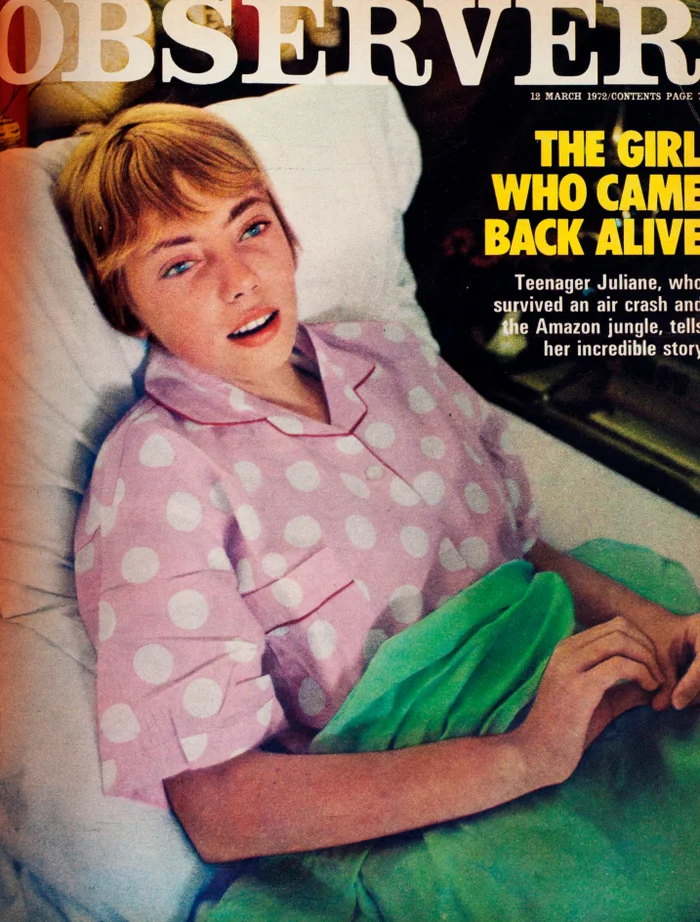
On Christmas Eve in 1971, LANSA Flight 508 took off from Lima, Peru, bound for the jungle city of Pucallpa. Aboard the commercial airliner were ninety-two passengers and crew members, including seventeen-year-old high school student Juliane Koepcke and her mother. Roughly twenty-five minutes into the journey, the aircraft flew into a violent thunderstorm and was struck by lightning. Severe structural damage tore the fuselage apart midair, plunging passengers and debris into the Peruvian Amazon from an altitude of approximately 10,000 feet.
Miraculously, Juliane survived the terrifying freefall. Experts believe that the three-seat bench to which she remained strapped rotated like a helicopter rotor, creating aerodynamic resistance. Updrafts from the storm and the dense jungle canopy further cushioned her descent, breaking her fall before she struck the rainforest floor.
When Juliane regained consciousness, she faced a grim reality. She suffered from a severe concussion, a broken collarbone, deep gashes on her arms and legs, a ruptured knee ligament, and a swollen eye. Worse still, she had lost her eyeglasses, wore only a thin summer dress, and possessed just one sandal. Surrounded by an unforgiving wilderness where dangerous wildlife, extreme humidity, and hypothermia posed lethal threats, her prospects of survival seemed virtually nonexistent.
Despite the overwhelming trauma, Juliane retained critical knowledge gained from her parents, who were renowned zoologists managing a biological research station in Peru. Remembering a crucial rule taught by her father, she understood that following water was her best hope of rescue. In the rainforest, small rivulets lead to creeks, which eventually flow into larger rivers where human settlements and boat traffic are typically located. Rather than remaining static at the crash site—where the thick vegetation completely hid wreckage from airborne search parties—she located a nearby brook and began walking downstream.
Her eleven-day trek through the jungle was an agonizing ordeal. The tropical rains soaked her constantly, while stinging insects and swarms of flies attacked her open wounds. Lacking provisions, she subsisted on a bag of hard candies she salvaged from the scattered luggage, drinking directly from muddy streams. Navigating knee-deep water was treacherous; stingrays buried in the riverbed and caimans posed constant danger, prompting her to test the riverbed with a stick before stepping forward. Moreover, an open wound on her arm became infested with fly maggots, causing immense psychological and physical distress.
Exhausted and starving, Juliane stumbled upon a small wooden shelter used by local lumber workers on her tenth day. Alongside the shelter, she noticed an outboard motor and a canister of gasoline. Drawing upon memories of treating animal infections at her parents' station, she poured gasoline over her arm wound, successfully driving out dozens of parasites. Unable to hike any further, she chose to wait inside the hut.
The following morning, three Peruvian foresters arrived at the hut by chance to inspect their boat. Shocked to discover the severely injured teenager, they treated her injuries, offered her nourishment, and transported her on an eleven-hour canoe journey to safety. Juliane later directed military search teams back to the wreckage site. Tragically, she learned that while fourteen other passengers—including her mother—had survived the initial impact, all had perished in the jungle before rescue teams could locate them, leaving Juliane as the sole survivor of Flight 508.
Rather than developing a phobia of the natural world, Juliane Koepcke went on to earn a doctorate in biology, dedicating her professional career to researching wildlife in the very rainforest that nearly claimed her life. Her incredible story stands as an enduring testament to the power of environmental knowledge, mental resilience, and the sheer instinct for survival.