
English (Original)
Long before anyone drew a border across North America, the Mississippi was already the continent’s main road. Native peoples such as the Choctaw, Ojibwe and the mound-building cultures of Cahokia lived along its banks and traded up and down it for thousands of years. The name itself comes from the Ojibwe misi-ziibi, meaning “great river,” and it drains all or part of thirty-one states, which is roughly forty percent of the continental United States.
For European powers, whoever held the river held the heartland. France claimed it first, but it changed hands several times, and by the early 1800s American farmers in Kentucky and Ohio depended on it to ship their grain and pork south to New Orleans. When Spain briefly closed the port to them, President Jefferson saw the danger and jumped at the chance to buy Louisiana from Napoleon in 1803. Overnight, the country doubled in size, and the river was finally in American hands.
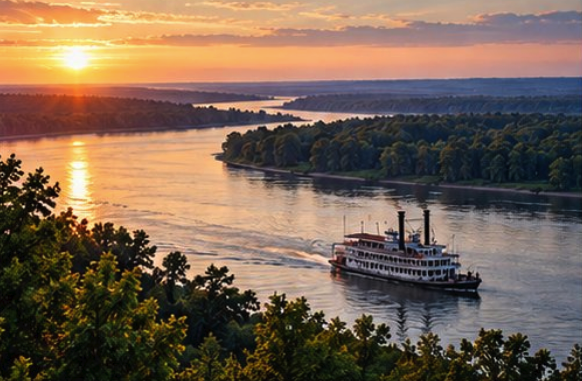
Then came the steamboat, which changed everything. Goods that once took months to haul upstream now arrived in days, and towns like St. Louis, Memphis and Natchez grew rich almost overnight. Mark Twain, who worked as a riverboat pilot before he became a writer, borrowed his pen name from the leadsman’s call for safe water.
The river also shaped the Civil War: the Union’s capture of Vicksburg in 1863 cut the Confederacy in two, and Lincoln said the Union would not be saved until the river “goes unvexed to the sea.”
The river has a darker side, too. Enslaved people were sold downriver in huge numbers, and devastating floods, especially in 1927, drove hundreds of thousands of Black Southerners from their homes and fed the Great Migration north.
Today, engineers keep the river in its channel with levees and locks, but it still has a mind of its own, and every few years it reminds people who is in charge.