
English (Original)
The Historical Mystery of His Alleged Flight from Galata Tower
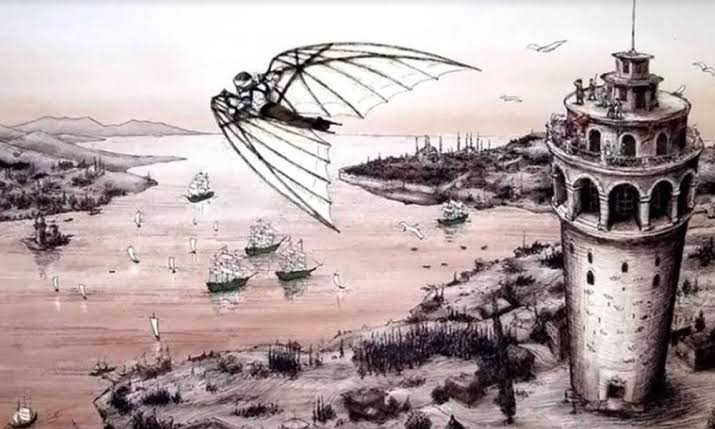
Hezarfen Ahmed Çelebi is one of the most fascinating figures in Turkish history, famous for allegedly flying from Galata Tower in Istanbul to Üsküdar in the seventeenth century. However, the historical evidence supporting this extraordinary achievement remains limited. The primary source describing the event is Seyahatname, a ten-volume travel account written by the Ottoman traveller Evliya Çelebi. According to his account, Ahmed Çelebi conducted preliminary experiments at Okmeydanı, where he tested a device resembling the wings of an eagle. He later launched himself from the top of Galata Tower, reportedly benefiting from the strong southwesterly wind known as the lodos, and reached Doğancılar Square in Üsküdar. Evliya Çelebi also claims that Sultan Murad IV witnessed the flight from a pavilion near Sarayburnu and rewarded the inventor with gold. Nevertheless, these details come primarily from Evliya Çelebi's narrative rather than independent historical records. Researchers have not established the existence of contemporary documents that conclusively confirm the flight, the Sultan's alleged reward, or Ahmed Çelebi's reported exile to Algeria. Similarly, no authenticated technical drawings, personal writings, or surviving examples of his flying apparatus have been identified in the sources examined.
This lack of evidence does not necessarily prove that the event never occurred, but it prevents historians from treating the story as a fully verified historical fact. From a scientific perspective, however, the possibility of gliding deserves consideration. If Ahmed Çelebi had constructed a lightweight device with sufficiently large wings, he might theoretically have travelled a considerable horizontal distance by descending from a high starting point. The distance between Galata Tower and Doğancılar Square is approximately 3.2 kilometres, making the alleged journey an impressive undertaking for someone using an early gliding apparatus. Nevertheless, the account provides no reliable technical information about the device's materials, weight, wing design, or flight duration. Consequently, it is impossible to reconstruct the flight scientifically with confidence. Some scholars have suggested that the story may preserve a memory of an actual experiment that was subsequently exaggerated, while others emphasise the possibility of literary embellishment. Although Hezarfen Ahmed Çelebi's alleged flight remains a fascinating episode in Ottoman history, the absence of independent contemporary records leaves its historical accuracy uncertain. A closer examination of Evliya Çelebi's account and surviving Ottoman documents may help establish whether this extraordinary story preserves evidence of an early attempt at human flight or reflects a narrative that became more elaborate over time.